

Morte dei macrofagi indotta dal dsRNA e rimodellamento polmonare
Abstract
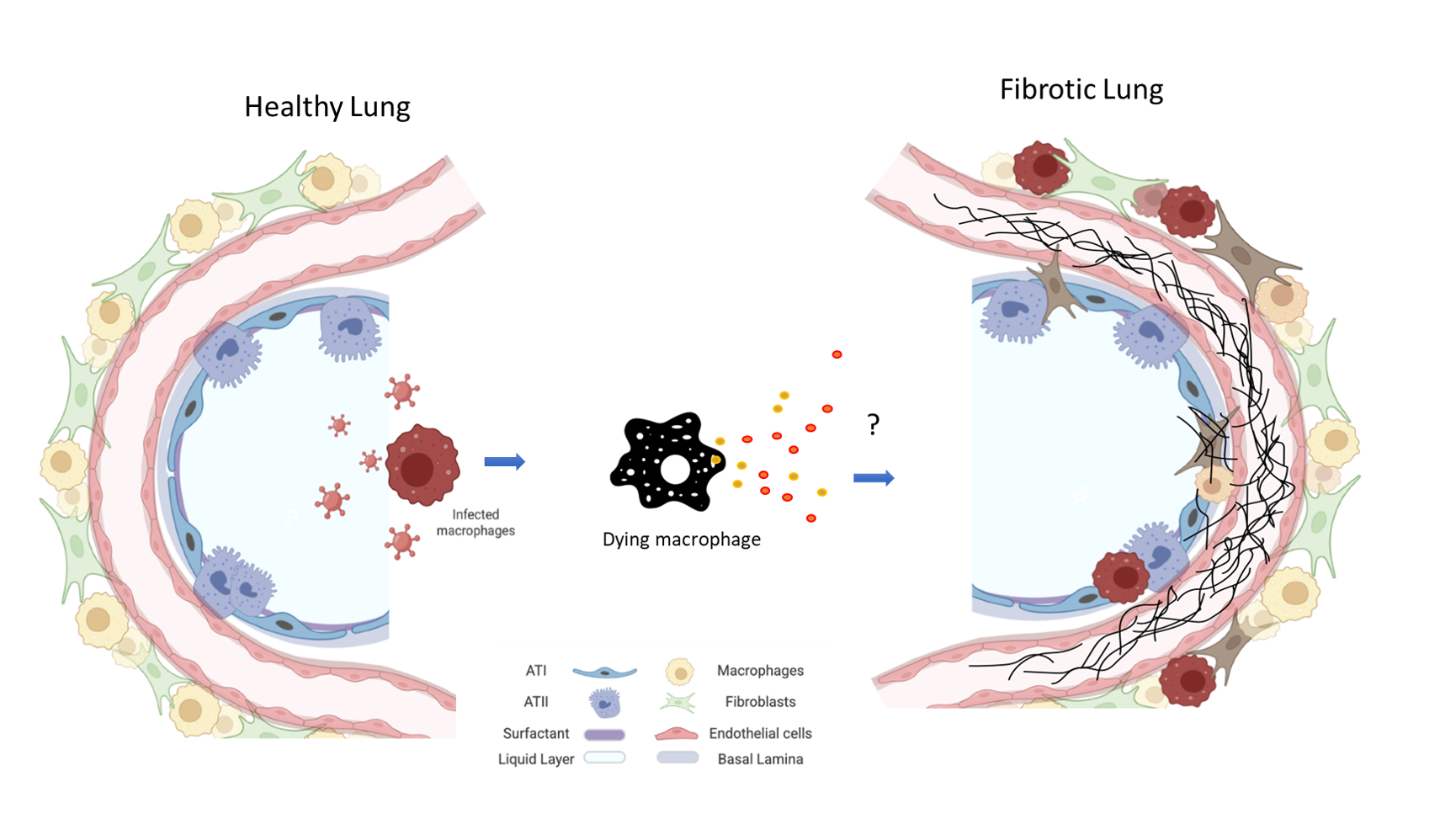
Viral infections are a major cause of acute lung injury and may trigger persistent inflammation and tissue remodeling. Macrophages play a pivotal role in the innate immune response against viral pathogens; however, when their activation is excessive or dysregulated, they can promote disease progression through the release of inflammatory mediators and damage-associated molecular patterns (DAMPs). The mechanisms by which these signals influence the behavior of lung fibroblasts, the key cells responsible for tissue repair and remodeling, remain incompletely understood.
The aim of this project is to investigate how inflammatory macrophage cell death triggered by viral RNA sensing affects lung fibroblast function and contributes to chronic inflammation and tissue remodeling. In addition, the project seeks to identify the molecular mediators responsible for macrophage–fibroblast communication, with the ultimate goal of uncovering novel therapeutic targets to prevent or limit virus-induced lung damage.
The project employs human monocyte-derived macrophages and primary human lung fibroblasts as in vitro experimental models. Viral infection is mimicked by stimulating macrophages with Poly(I:C), a synthetic analogue of double-stranded RNA. Macrophage inflammatory responses and secreted proteins are characterized using biochemical approaches and mass spectrometry. Conditioned media are subsequently used to evaluate their effects on fibroblast function. Finally, proteomic data are integrated with bioinformatic ligand–receptor analyses to identify the molecular pathways underlying macrophage–fibroblast communication during virus-induced inflammation.
Pipeline
-
CLINICAL
NEED -
DISEASES
ANALYSIS - DISCOVERY
-
PRECLINICAL
VALIDATION -
PRECLINICAL
DEVELOPMENT -
CLINICAL
STUDIES
Principal Investigator
Contatto
Team di progetto:
Marco Buscetta, PhD
Aree terapeutiche:
Prodotto:
Collaborazioni:
Università di Messina
Philipps-Universität Marburg
Scarica il pdf del progetto