
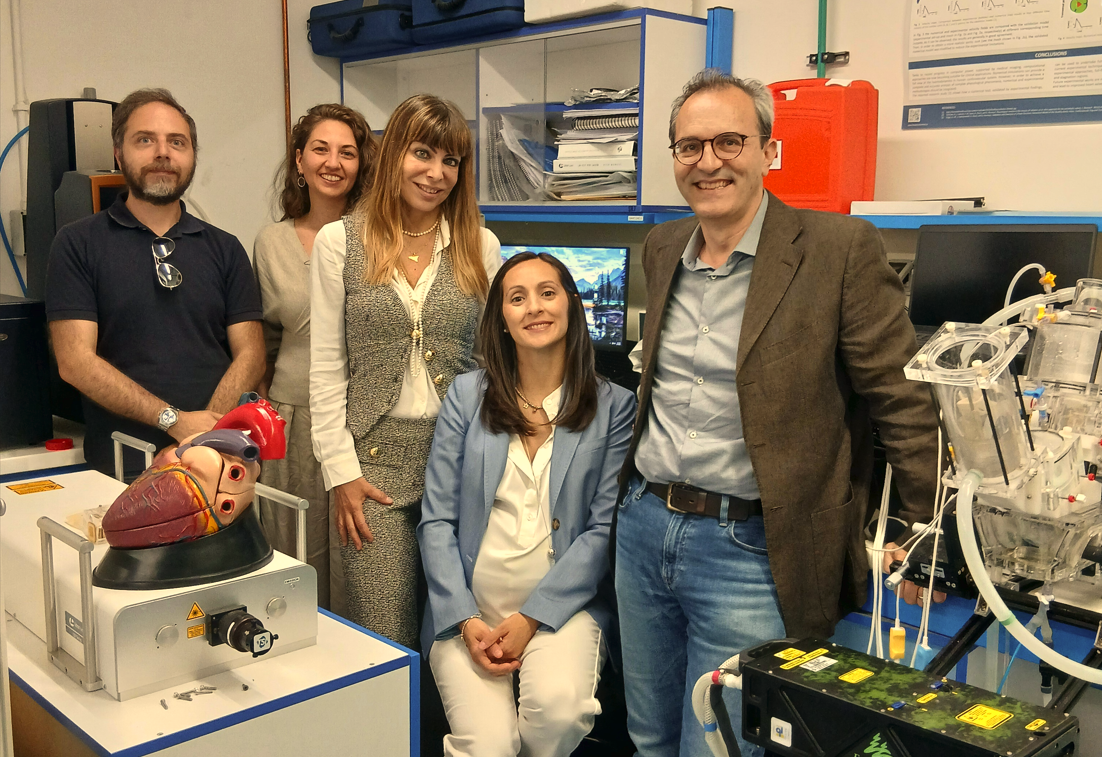
ARTES 4.0, Ri.MED Foundation and Xenia Progetti join forces to develop a precision medicine platform supporting clinicians in the assessment of thrombotic risk
Palermo, May 25 – Predicting thrombotic risk and the likelihood of stroke development in patients with atrial fibrillation by integrating currently adopted clinical criteria into an innovative platform based on artificial intelligence and machine learning algorithms trained on datasets derived from individual anatomical characteristics and blood flow simulations. This is the goal of STRIKE – STroke RIsK prEdiction in Atrial Fibrillation, the research and development project launched by the ARTES 4.0 Competence Center, the Ri.MED Foundation and Xenia Progetti, aimed at developing a biomedical device capable of supporting clinical decision-making in thromboembolic risk assessment in an entirely new way.
Atrial fibrillation, a condition affecting more than 50 million people worldwide and representing the most common sustained cardiac arrhythmia globally — with 4.5 million cases in Europe and 1 million in Italy, figures expected to rise rapidly due to population aging — is a cardiac rhythm disorder characterized by irregular heartbeats and is one of the conditions associated with thrombus formation and severe complications, including stroke. One of the most critical elements concerns the left atrial appendage, a small structure of the atrium whose morphology differs significantly from patient to patient. In individuals with atrial fibrillation, this region may lose its normal contractile function and contribute to clot formation: indeed, more than 90% of thrombi associated with this condition are estimated to originate in this area of the heart.
To address this need, STRIKE will develop a digital platform capable of transforming clinical imaging into three-dimensional models and integrating them with numerical simulations and artificial intelligence algorithms to support risk assessment. The system will be designed to process patients’ CT scans, automatically segment the left atrial appendage, generate a three-dimensional reconstruction, and simulate blood flow dynamics within the analyzed anatomical structure. This process will enable the generation of a thromboembolic risk index based on each patient’s anatomical and fluid-dynamic data, supporting clinical assessment, prognosis, and therapeutic planning. These outputs will be integrated with traditional clinical parameters based on patient history, age, and comorbidities.
The platform will be available to healthcare professionals both as a service and through on-premise installation, depending on the organizational and infrastructural needs of clinical facilities.
The project stems from the integration of scientific, technological, and industrial expertise. The Ri.MED Foundation, an international center of excellence focused on biomedical and biotechnological research based in Palermo and established through a public-private partnership involving the Italian Government, the Sicilian Region, the Italian National Research Council (CNR), the University of Pittsburgh, and its medical center, will contribute its scientific and bioengineering expertise for the creation of the synthetic dataset of left atrial appendage models, the implementation of numerical models, and the development of machine learning techniques.
ARTES 4.0, the Italian national Competence Center highly specialized in robotics and artificial intelligence and funded by the Italian Ministry of Enterprises and Made in Italy, will contribute to the development of the technological component dedicated to automatic three-dimensional model extraction together with its partner Mediavoice, a deep-tech company specialized in innovative software and AI-based solutions. ARTES 4.0 will also oversee coordination, communication, and valorization activities.
Xenia Progetti, a well-established Information Technology company and ARTES 4.0 partner, leads the project as coordinator. The company will develop the software platform for thromboembolic risk assessment and therapeutic planning support.
STRIKE embodies the Science-driven Innovation model promoted by ARTES 4.0 by applying it to healthcare technologies: the project integrates scientific research, artificial intelligence, physical simulation, and digital expertise into a technology transfer pathway aimed at delivering a solution with high clinical and practical value, expected to contribute to healthcare efficiency through optimized diagnosis and patient care management.
“Current diagnoses are mainly based on clinical parameters built on patient populations sharing common characteristics. STRIKE aims to develop a more personalized approach by integrating into the clinical pathway information that is still difficult to use today: the shape of the left atrial appendage, blood flow behavior, and patient-specific variability. Turning these elements into personalized support for patients means bringing bioengineering research increasingly closer to precision care,” says Danila Vella, Scientific Coordinator at the Ri.MED Foundation.
“We are proud to lead a project designed to move beyond the experimental dimension and engage directly with the operational needs of healthcare facilities, simplifying access to complex information and making it useful in decision-making processes,” states Giuseppe Sorbello, President of Xenia Progetti.
“Our contribution creates the innovative conditions necessary for a complex technology to progressively become usable and sustainable for healthcare systems,” adds Fabrizio Giacomelli, founder and CEO of Mediavoice.
“STRIKE confirms the importance of building structured connections between advanced research and real-world applications. We established a strategic partnership and developed a Health Bioengineering line at our Palermo headquarters with the goal of ensuring that the innovation we generate can be fully translated into tools capable of supporting citizens’ health,” concludes Enza Spadoni, Head of the ARTES 4.0 Palermo office where STRIKE activities are being developed.