
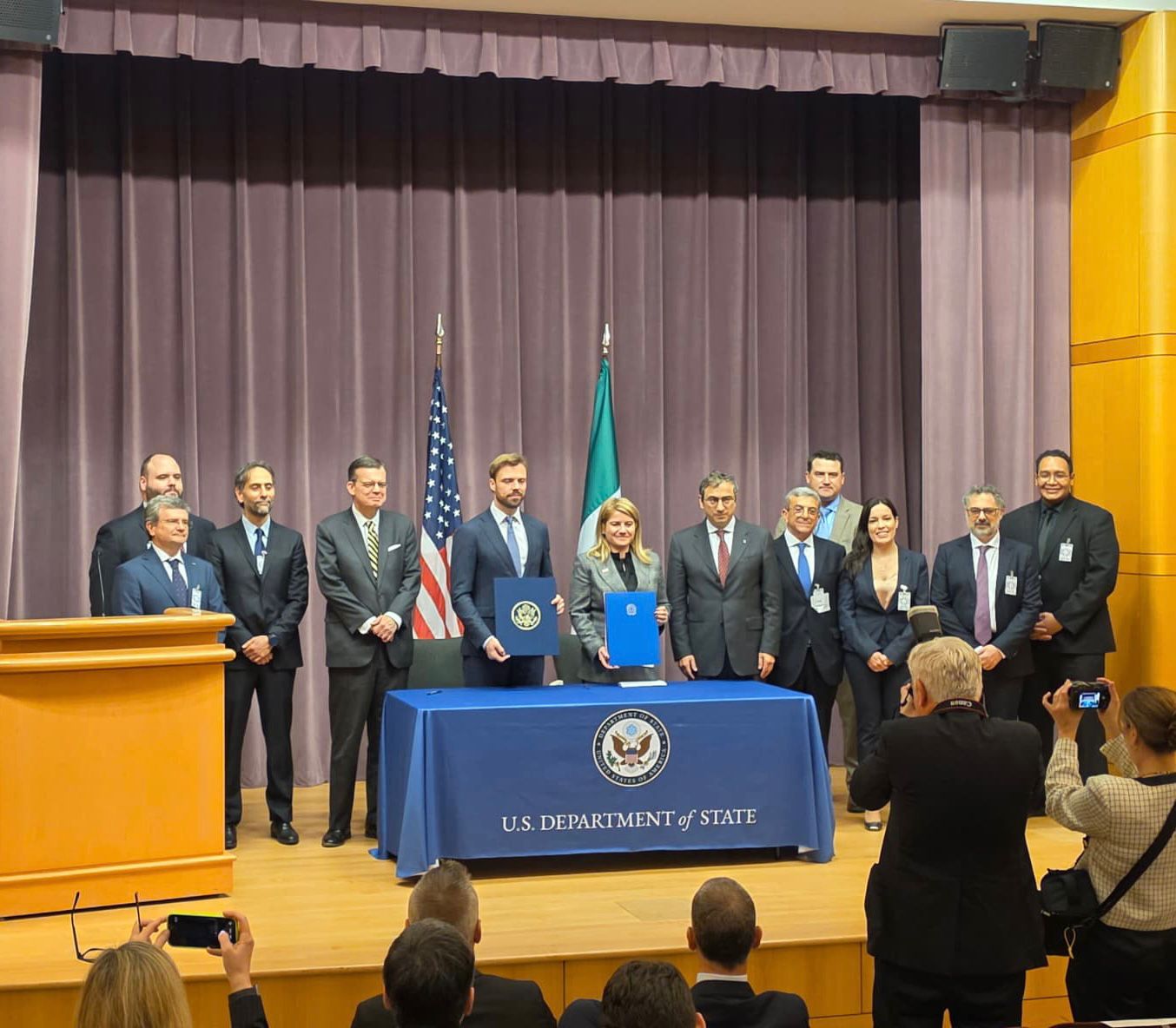
Palermo, April 13, 2026 – The 15th meeting of the Italy–United States Joint Commission on Scientific and Technological Cooperation was held in Washington in recent days, co-chaired by the U.S. Department of State and the Italian Ministry of Foreign Affairs and International Cooperation.
The meeting focused on strengthening collaboration in four strategic areas for global competitiveness: artificial intelligence, nuclear energy, advanced materials, and biotechnologies. For each sector, technical working groups were established and co-led by Italian and U.S. representatives, confirming the integrated approach between the two countries.
The Biotechnology Working Group was co-chaired, for the Italian side, by Antonio D’Amore — a scientist at the Ri.MED Foundation for over 15 years, where he leads the Tissue Engineering Group, as well as Full Professor at the University of Palermo and Associate Professor at the University of Pittsburgh — who assembled and coordinated a working group composed of representatives from universities, research institutions, venture capital, companies, and technology transfer networks, including Human Technopole, Politecnico di Milano, CDP Venture Capital, and the PerfeTTo network. Also participating were IRCCS ISMETT in Palermo, the University of Pittsburgh, and UPMC, which together with Ri.MED have long represented a well-established strategic cluster integrating research and clinical care between Italy and the United States.
“The Biotechnology Working Group was established to strengthen a structured collaboration between Italy and the United States, capable of connecting research, innovation, and capital, and of rapidly translating scientific excellence into concrete solutions for healthcare, industrial competitiveness, and regional development,” said Antonio D’Amore. The group identified four main lines of action: joint strategic planning to define shared priorities and development roadmaps; access to international grants, with particular reference to joint calls to be submitted to the European Research Council and new funding schemes from the U.S. National Institutes of Health; international training programs, involving leading philanthropic partners such as the Armenise-Harvard Foundation and ISSNAF; and dissemination activities, including a major international biotechnology event planned for 2027 at the new Ri.MED research center currently under construction in Carini.
“Collaboration between Italy and the United States fosters the exchange of knowledge and expertise in patents, intellectual property, inventions, and clinical applications, while also enhancing the ability to attract productive investments,” said Paolo Aquilanti, President of the Ri.MED Foundation. “In a context of increasing global competition, cooperation among Western countries is not only desirable, but essential,” he added, underscoring the strategic value of these initiatives.
The active participation of the Ri.MED Foundation in the JCM confirms its role in translational research as an institution capable of integrating science, clinical practice, and industry, and of contributing to the development of competitive, internationally-oriented innovation ecosystems.