
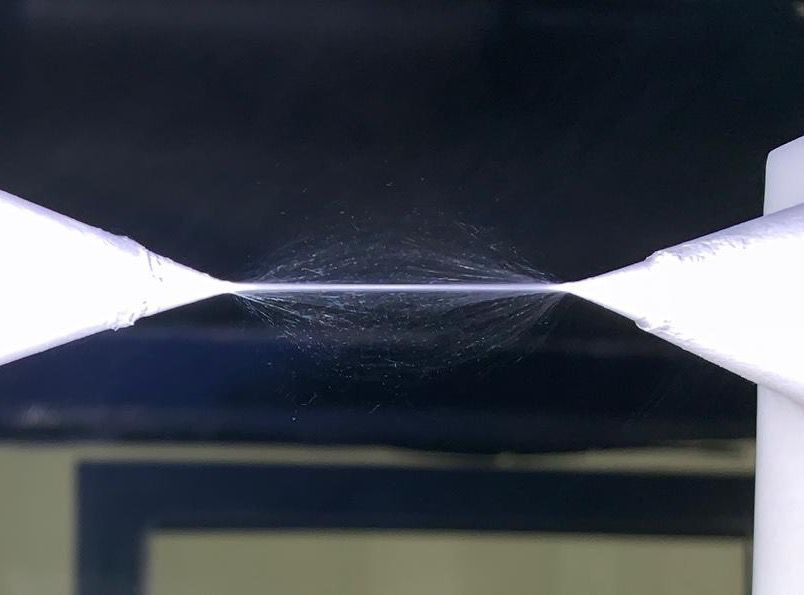
- The procedure was carried out within the BioChord project, supported by the European Research Council (ERC) through a prestigious Proof of Concept Grant and coordinated by the Ri.MED Foundation
- The project is led by Antonio D’Amore, Group Leader of the Cardiovascular Tissue Engineering Group at the Ri.MED Foundation, Full Professor of Bioengineering at the University of Palermo and at the McGowan Institute for Regenerative Medicine, University of Pittsburgh, USA.
- The operation was successfully performed at the laboratories of the Università Cattolica del Sacro Cuore, a project partner, under the guidance of Massimo Massetti, Director of the Institute of Cardiology and Director of the Cardiovascular Area at the Università Cattolica del Sacro Cuore.
Palermo, 3 March 2026 – Last month, for the first time in the world, a bioengineered chordae tendineae was successfully implanted in a large animal model. The procedure, performed by Maria Grandinetti at the Università Cattolica del Sacro Cuore, marks a historic milestone for tissue engineering and for the treatment of mitral valve diseases.
The operation was carried out within the BioChord project (Bioengineered chordae tendineae for repairing and regenerating heart valves), supported by the European Research Council (ERC) through a prestigious Proof of Concept Grant. Members of the project team include Arianna Adamo, Scientist in Mechanobiology at the Ri.MED Foundation, and Maria Emiliana Caristo, responsible for animal welfare and for the experimental research center at the Università Cattolica del Sacro Cuore.
Mitral regurgitation affects more than 24 million people worldwide. This condition is sometimes caused by the deterioration or rupture of the chordae tendineae, the “tethers” that ensure proper closure of the valve. To date, replacement of the chordae tendineae has relied mainly on the use of sutures made of expanded polytetrafluoroethylene (ePTFE, Gore-Tex). However, these solutions present structural limitations: being made of synthetic material, they are more rigid and can consequently induce ischemia of the papillary muscles or be exposed to rupture or fibrosis.
BioChord introduces a paradigm shift. It is not simply a suture material but a tissue engineering solution: a fully biomimetic bioengineered polymeric chordae tendineae designed to faithfully reproduce the structure and function of natural chordae and eventually “disappear” by degrading and being replaced by the patient’s own tissue.
“The cornerstone of our work remains biomimicry: in the laboratory we create chordae tendineae with properties and functions that mirror those of tissues in the human heart,” explains Antonio D’Amore, Principal Investigator of BioChord and Group Leader of the Cardiovascular Tissue Engineering Group at the Ri.MED Foundation. “Made of biodegradable materials, BioChord is designed to provide immediate mechanical support to the valve apparatus while at the same time guiding the growth of the patient’s own tissue, gradually transforming into a natural and functional chordae tendineae. Our laboratory was the first to introduce this technique—now covered by a patent granted for development and commercialization to our spin-off Neoolife—and to evaluate it in a clinically relevant scenario within the BioChord project.”
BioChord originated within a broader project – funded in 2020 by the European Union with €2 million – aimed at engineering the entire mitral valve. The result is a bioengineered polymeric valve capable of regenerating the patient’s tissue, reducing the need for anticoagulant drugs, calcification, and the risk of further surgeries.
“This work later paved the way for the use of bioengineered chordae tendineae also as a standalone solution—that is, as a specific prosthesis for damage to the chordal apparatus. This is how the idea for BioChord was born” concluded Antonio D’Amore.