
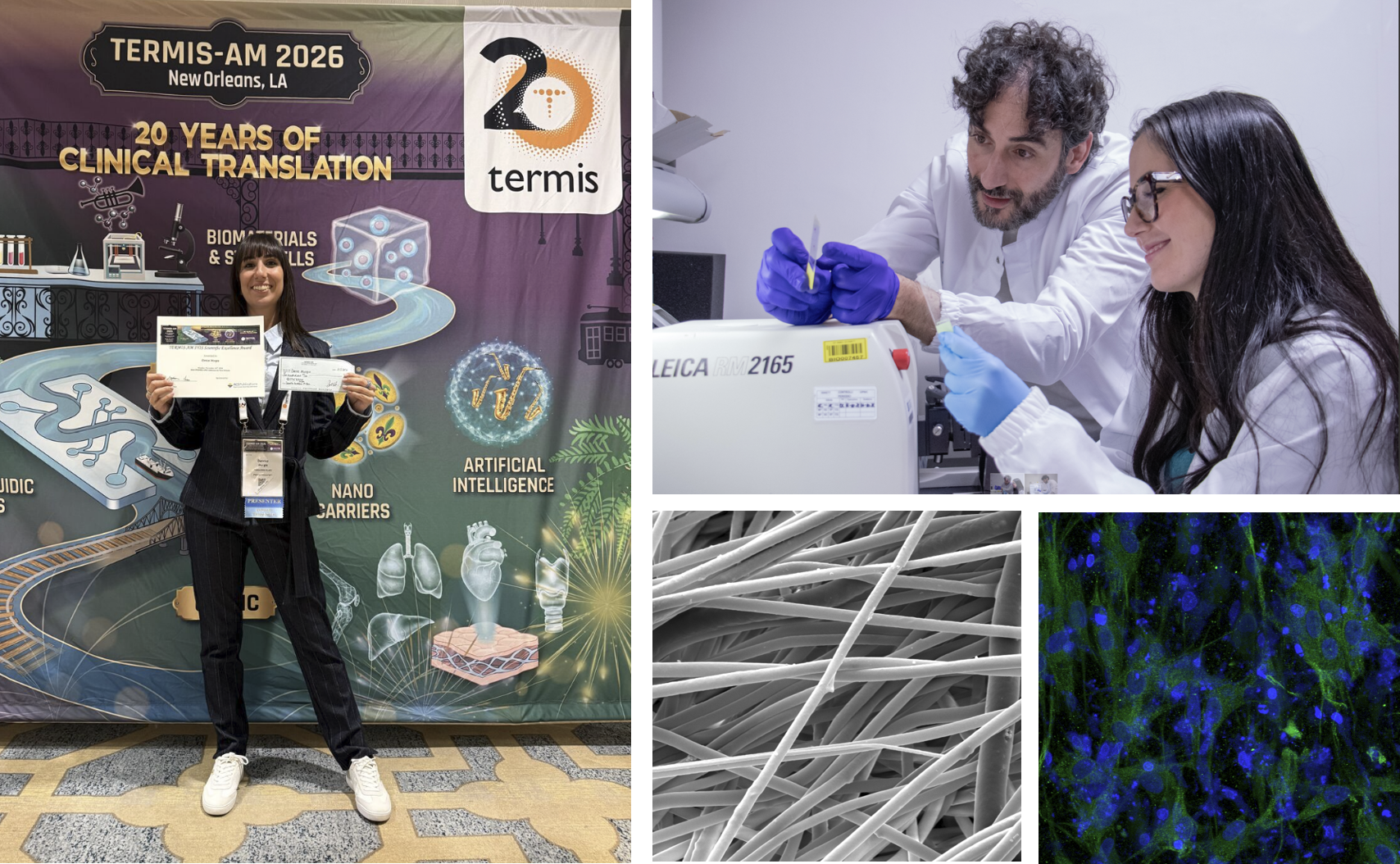
The Ultracart Regenera project is testing whether remotely activated piezoelectric biomaterials can stimulate cartilage cells. Early in vitro results are encouraging.
- Sicilian researcher Denise Murgia received the 2026 Scientific Excellence Award at the international TERMIS-AM conference in New Orleans.
Palermo, November 23, 2026 – Can magnetic fields and smart biomaterials work together to stimulate cartilage cells from a distance? That is the question behind Ultracart Regenera, a project by the Ri.MED Foundation’s Musculoskeletal Tissue Engineering group. The project was presented in New Orleans at the annual conference of the Americas Chapter of the Tissue Engineering and Regenerative Medicine International Society (TERMIS-AM), where Sicilian researcher Denise Murgia received the 2026 Scientific Excellence Award.
The study addresses a longstanding challenge in regenerative medicine: finding effective ways to help repair cartilage. Cartilage covers the ends of bones in the joints and has very little capacity to repair itself.
The prototype under study at Ri.MED is a scaffold made of piezoelectric fibers containing magnetic nanoparticles. The idea, still at the preclinical stage, is to use an external magnetic field to slightly deform the scaffold without direct contact. As the fibers deform, they generate small, localized electrical signals that can stimulate the cells. The aim is to mimic some of the signals that cartilage cells experience in a healthy joint.
“When we move, our cartilage bears loads. In the lab, we try to reproduce some of those signals to understand what prompts cells to make the building blocks of healthy tissue and how that might help regenerate articular cartilage,” explains Roberto Di Gesù, who leads the Ri.MED Foundation’s Musculoskeletal Tissue Engineering Laboratory.
In in vitro tests on human cartilage cells, the combined mechanical and electrical stimulation led to greater deposition of type II collagen, a protein essential to the structure of cartilage. Further studies are needed to determine whether this laboratory response can improve cartilage repair in the joint in vivo.
The conference contribution was co-authored by Denise Murgia, Francesca Romano, and Roberto Di Gesù of the Ri.MED Foundation, and Riccardo Gottardi of the University of Pennsylvania.
“I’m honored to have had the chance to present our work at TERMIS-AM,” says Denise Murgia. “I’m coming back from New Orleans with new ideas and renewed motivation. I’d like to thank the entire Ri.MED team. This is a team win!”